
Bite it, you scum: Iran & the GG Allin theory of political economy
How Iran's shadow banking system collapsed and why the killing is all that's left, an essay explaining Iranian finance and GG Allin's punk degeneracy mirroring state violence

“One day when your end is near
I’ll be laughing at your fear
When you’re gone you’ll be no one
Who’ll be fucking up my fun? No one!” — G.G Allin
Author’s note: This essay was written and substantially completed before the Israeli and American strikes on Tehran began on the night of February 27, 2026 as I was busy dealing with close reading of some speculative fiction earlier this week (see here)
The analysis below describes the collapse of Iran’s informal financial system and the parallel banking infrastructure that kept the country’s economy alive for forty years under sanctions. That system was already long dead before tonight.
What you are watching now, in my view, is the next chapter of what this essay describes. I am publishing it because understanding what broke, and how, matters far more tonight than it did yesterday. Everyone has an Iran take and everyone agrees the women are very attractive, the food is good, the people are kind, blah blah blah — but few of you were born in Tehran and even fewer of you who are writing essays for free instead of being a lawyer or a doctor.
The first rule of Persian fight club is that you don’t talk about Persian fight club.
The second rule is that you insist on paying everyone’s tab while everyone else insists on paying everyone’s tab and everyone figures out ways to get around everyone.
The third rule is that one of your aunts will comment on your appearance, your weight, your life prospects, and the specific way you are failing at something somehow, and you cannot say plainly to auntie “bite it you scum,” because the fourth rule is that everyone at this table will be outraged and the fifth rule is that they will never forgive you and the sixth rule is that you will never be invited back (which was the goal anyways, mashallah, though we are not Arabs).
The seventh rule is that not being invited back is a death sentence because this table is where all the good warm food is along with all the cold and dark long-buried family secrets as lore lurking in pauses, casual comments rallied out of nowhere that render you speechless with the brutal efficiency of communicating something you never wanted to know, say, about your father.
A Persian family dinner is a financial system that runs entirely on performance and so is Iran’s economy, yet the only person who ever truly explained what happens when the performance stops through abhorrent behavior was GG Allin, an American musician, punk, and degenerate who walked on stage already bleeding and made it impossible for anyone to keep pretending it was a performance, which is exactly what the Iranian regime does when it kills its own people, not because it is strong but because killing is the only function it has left, the last spasm of an institution that has nothing behind the uniform except the violence itself.
Sanctions this, sanctions that, you’ve heard all about sanctions in Iran, of course, but do you know how actual financial transactions are done? Well, the bazaari merchant class is Iran’s shadow banking system as they are the levers running it.
In practice, this means their relationships are the credit lines, reputations are collateral, their shops are the branches, and the whole thing ran for 40 years as the actual financial infrastructure of a country, a bandage on the gaping wound of Iran’s formal banks being sanctioned into irrelevance.
Now, just like shadow banking system in Iran based on social cohesion and capital, when Persians fight over the check, it’s called ta’arof and it’s a collective clearing mechanism where guilt is collateral, enforcement is the threat of being socially frozen out, and the ledger lives in everyone’s memory. When your aunt comments on your nose, it’s not small talk, it’s small talk, intel gathering, and an overall social credit check.
When you scale that Persian family dinner from six people to 92 million, the architecture is identical with trust-based credit, reputation as collateral, and social exclusion as the enforcement mechanism for bad actors. This shadow banking system was eaten up from the inside by the Islamic Revolutionary Guard Corps while sanctions degraded it from the outside. The death knell, however, was the rial doubling in 12 months to collapse in December 2025. The regime killing over 6,000 people in response was not just an authoritarian crackdown but reinforcement of the fact that an economy decimated inside and out means that there is nothing left, because you don’t shoot your own depositors if you have any other tool left.
Here’s how I’ll work through Iran’s shadow banking system - first, I’ll introduce what the bank run looked like, then the infrastructure underneath the bazaar which is the financial system of the shadow banking system and its practicalities. Following that, I’ll discuss how this shadow banking economy was decimated from internal and external forces, and how the catalyst which broke it signified a new political reality for the country. Finally, I reflect on why the killing is proof that it’s over for Iran by introducing GG Allin’s work as a parallel to the Iranian government, and what may come next.
I. A bank run without a building: don’t mess with the peaky Bazaari merchants
What no one appears to have said about the situation in Tehran’s Grand Bazaar in late 2025 is that it was not just a protest, but that it was a bank run too, except the bank didn’t have a building. Thinking about Iran from a Western perspective will not necessarily illuminate systems here because we default to the schemas we know for the cultural blueprints which guide us, and Western analysts covering this story treat the bazaar like a voting bloc (much as an individualistic culture would) whereas I’m going to treat it like a balance sheet (which is what a collectivist cultural slant would). The way credit is measured in Iran is also social, and you cannot forget this.
For forty years the bazaari merchant class has functionally operated as Iran’s parallel banking system When formal banking was sanctioned into irrelevance and the Iranian Revolutionary Guards Corps were busy building their own little extractive kleptocracy, the bazaar kept roughly 92 million people’s economy breathing. How did they do this? Merchants extended credit to each other the way banks issue loans, as they wrote IOUs that circulated like currency. Currency exchange dealers converted rials to dollars and back, connecting Tehran to Dubai to Istanbul the way a bank’s international wire desk connects New York to London or some hedge fund manager on fintwit with his various e-girls throughout the U.S.
When thousands of merchants owe each other money in every direction, trusted intermediaries calculate who actually owed what to whom and then cancel out the overlapping debts so that less cash had to move. That move is called clearing, which every major financial system on earth does, but the bazaar did it without the separated buildings, regulators, or Bloomberg terminals.
The Iranian rial collapsing in December 2025 marked a turn from turbulence to terror on the streets in Tehran in the government’s response to the protests. For context, the rial began 2025 at 817,000 to the dollar and nearly doubled to 1.42 million in December 2025. Food prices were up 72% year-on-year alongside the degradation of the currency in an environment already weakened by the impact of sanctions enforcement on cross-border settlement corridors.
Prior to this, historically, the post-revolution deal between the merchants and the IRGC was simple: bazaari merchants got import licenses, preferential exchange rates, and political access while the clerical establishment got financial support and a loyal commercial class.
The arrangement held for a long time the way a hedge fund manager holds with his various e-girls, the entire aesthetic of the relationship centered around shared dysfunction and emotional turmoil fueled by delusion and hard drugs, which is to say it worked fine until the e-girl decided she wanted your portfolio too, though you signed up to be her secondary option and she’s never going to leave her primary partner. The bazaari merchants always knew they were subordinate to the real power structure and would never attain it because it was not their birthright to such power. Khamenei and the clerical establishment were the primary partners, and the IRGC was never going to choose commerce over power the same way the e-girl is never leaving her primary rich guy for the finance guy bankrolling her lifestyle. The merchants entered the arrangement knowing the terms. They knew they were the side piece, and side pieces don’t get to complain when they get cleaned out by the e-girl’s emotional jihad, whether it be financially, emotionally, or in whatever way that makes some of these hedge fund managers bankrupted excuses of human beings incapable of empathy.
Now, in Iran, through front companies, bonyads, and a breathtaking volume of no-bid contracts, the Guards moved into construction, telecom, energy, import-export, petrochemicals, and basically anything that generates cash. Conservative estimates put Khamenei-linked para-statal institutions at controlling roughly 60% of national wealth. The Mostazafan Foundation alone operates like a Fortune 500 company with the accountability structure of a Telegram chat. For the bazaari merchant class, this meant that they were getting shut out and getting systematically poorer, which in turn meant the financial infrastructure they operated was getting thinner with less capital in the system and shorter maturities. Consequently, this leads to higher counterparty anxiety and worse terms. Imagine what it’s like when merchants who used to extend 60-day terms started demanding 30, then 14.
From the outside, sanctions enforcement was destroying the corridors. The bazaar’s cross-border settlement capacity depends entirely on external nodes, and Dubai is the big one. U.S. Treasury enforcement spent years methodically ripping up every external node the bazaar depended on, which means spreads widen as settlement times lengthen and counterparties become harder to verify. Every OFAC (Office of Foreign Assets Control) designation (from the Specially Designated National list) raises the cost of operating every adjacent node because it’s like a zombie virus as a designation means no U.S. person or institution can transact with you. In turn, spreads widen as settlement times lengthen and counterparties become harder to verify.
II. The infrastructure of Iran’s shadow banking system
A sarraf shop in the Tehran bazaar looks, to a Western journalist parachuting in, like a currency exchange counter, but it is much more than that. Think of your local rhetorical Iranian sarraf as three financial institutions crammed into a space the size of a Manhattan bodega though a Persian cat wearily judging you from a dimly lit corner is not guaranteed. The sarraf is a currency trader, buying and selling rials, dollars, euros, dirhams, and quoting prices that reflect how risky he thinks each transaction is. He’s also a wire transfer service, moving money from Tehran to Dubai to wherever and whenever through a network of partner sarrafs in each city, no SWIFT code required, no bank involved. He’s also a middleman who connects buyers and sellers across borders when the formal banking system won’t touch Iranian money. There’s a term for the sarraf in the world of international banking, since the sarraf’s connecting function is called correspondent banking. What JPMorgan does when it processes a payment between a bank in Germany and a bank in Brazil is what the sarraf does with a phone and a handshake.
In other words, when formal banking channels are sanctioned shut, the sarraf network is the banking channel and the actual infrastructure through which trade happens.
Sitting alongside the sarraf system: trade credit. A wholesaler in the Grand Bazaar imports electronics from Shenzhen. He does not pay cash upfront but receives goods on rolling credit, issuing a safteh, a written promise to pay a specific amount by a specific date, signed, witnessed, and enforceable through the bazaar’s social network. In the formal financial world, this is called a promissory note, and when large companies issue them to raise short-term cash, they call it commercial paper. When it is issued to me for my student loans used to study finance, I write these essays for free to keep my writing accessible to all audiences but the majority of my audience seems to involve highly paid professionals who consistently read me with 40% on average opening rates at 2-3x a read each, that’s not a promissory note, that’s called a joke. Pledge here to pay off my promissory notes in part.
That safteh written promise however doesn’t just sit in a drawer, but the person holding it can pass it to someone else as payment in the way you’d endorse a check, or he can sell it to someone for cash today at a small discount. Does this sound like something we’d call bonds? Yes, yes it is. This is how the bazaar creates liquidity out of thin air, as at any given moment, the Grand Bazaar contains thousands of these overlapping IOUs circulating between merchants, and if you mapped them, the web of who-owes-whom would look exactly like what Wall Street calls a money market. A money market is just a system where short-term debt trades between participants, and that’s what the bazaar is though it just doesn’t call itself that. The Iranian bazaari merchant class ran the shadow banking system of the country and for forty years it kept 92 million people’s economy alive. Then two forces spent twenty years destroying it from opposite directions and the currency collapsed.
III. The collapse
When the rial began depreciating, FX dealing froze first as the sarrafs can’t quote stable prices when the rate moves double digits in days. Most stopped quoting altogether, and trade credit became unpriceable. As you cannot issue a 30-day safteh in rials if you don’t know what rials will be worth in 30 days, clearing collapsed. When in freefall, netting positions become arguments and trust erodes fast when every settlement feels like a zero sum equation where someone’s getting screwed. Since trust is the only collateral in this system, it cannot function in such conditions.
Cash-in-advance became the only mode, so the entire system reverted to spot transactions which meant that smaller traders most dependent on rolling credit went under first. They are the ones who shut their shops, which is what the world saw on December 28. It was not a political statement but a liquidity crisis in the form of closed shutters.
Then the internet went down and the system split in two as the shutdown that began in early January, with over 100 hours of near-total blackout, was understood globally as censorship but it was also a financial infrastructure attack on the bazaar’s remaining settlement capacity. There are reports of merchants with Starlink terminals maintaining contact with counterparties in Dubai and Istanbul, settling in USDT while the rest of the bazaar operated blind. The Wall Street Journal reported thousands of terminals entering the country with connected merchants who can still access hard-currency settlement rails. Disconnected merchants, however, are trapped in a collapsing rial-denominated environment with no way to clear, price, or settle anything. It’s not a tale of two cities but a tale of bazaars and two economies for the merchants, so the ones who lost everything are the ones on the street. The merchants who managed to keep their satellite connections and stablecoin wallets will be positioned for whatever comes next.
IV. The show
Now I need to talk about the killing, because if I write about financial plumbing and don’t connect it to the people who are dead, I’ve written the wrong essay.
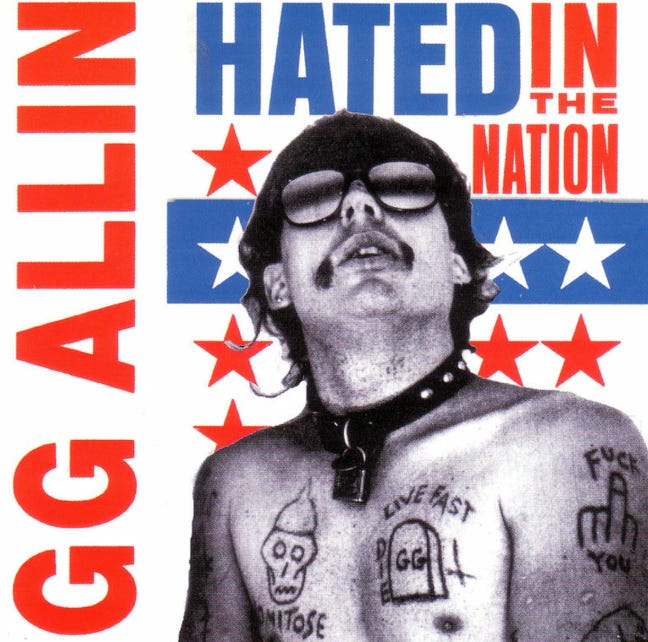
If you don’t know GG Allin, he was unabashedly violent and anti-social on purpose - he would, for example, walk on stage and smash open his own forehead with the microphone before the first song. Or he’d strip naked, defecate on stage, smear it on himself, throw it at the audience, attack anyone within reach, all total chaos, pandemonium, and repulsion instigated on purpose by him for the sake of it.
Most GG Allin shows lasted less than fifteen minutes before someone pulled the plug because it got too extreme for them. It was not the performance of extremeness they were anticipating, even though reports made it clear Allin was very serious about what he did and said and said he’d do.Every venue that booked him already knew what was coming, just like the audience buying tickets and the promoter promoting them knew what was coming. Everyone showed up and pretended the normal rules for performance still applied, that there’s a stage and there are seats and security maintains order and the performer performs, no blood spilling. But GG proved every single time that none of those agreements existed and he didn’t destroy the social contract. GG Allin demonstrated his disregard for the social contract by showing he could impose his violence and will on others by the degeneracy of his antics that was beyond any performance they had preconceived.
Remember I told you in the opening there was a GG Allin theory of political economy?
Remember how in the family dinner, everyone is performing or everyone knows exactly what it costs and refuses to say so? Just like the bazaar operated the informal economy and the regime provided security and took its cut, the performance of that parasitic relationship is gone too. The IRGC ate the balance sheet as foreign sanctions proved a death knell, so the formal banking system went functionally insolvent as credit instruments stopped clearing. Yet everyone kept showing up and performing their roles because the alternative was to stop performing, and stopping the performance at a Persian dinner table or in a Persian economy means the same thing: you don’t get invited back, and not being invited back is a death sentence. So everyone kept pretending just like the venues who booked GG Allin kept pretending the normal rules would apply this time and he wouldn’t wreck havoc.
What follows is security forces firing into crowds of merchants and students and workers, and that is like GG Allin’s unhinged violence on stage but demonstrated through the state as an actor. The unabashed disdain for human life through violence, sordid violence, has resulted in the murder of thousands of people. When you place it in the context of a punk show, to some it sounds obscene. Yet the comparison isn’t disrespectful, in my view, it’s the opposite. Every time an authority uses language that accidentally dignifies the killing with something vague and airy like “the regime deployed security forces”, “authorities escalated their response”, and more? That is the language of institutions that treats massacre like governance, like a fixed decision made by a functioning state weighing options.
The GG Allin framework says there is no pretense, stop dignifying this, and drop the veneer, there is no performance except for the unhinged violence I’m about to commit because I can and in defiance of everything you’d expect it not to be.. Allin never held himself back from his extremities on stage, just like Iran has never held itself back from extremities on and off stage.
What you are watching is not an institution exercising power but imposing its will through killing and causing carnage. The IRGC firing into crowds is not a government putting down unrest, it is a man covered in his own blood in a room where every agreement has already collapsed, doing the only thing he knows how to do because he has no other capacity left, just like GG Allin performing.
Think about how authoritarian crackdowns usually work, as they are political grievances with economic lives attached. The regime cracked down and people eventually went home because they have shops to reopen, credit lines to maintain, and customers to serve. The cost of staying out on the streets has exceeded the cost of going back to work. That calculus is what every authoritarian regime depends on, since it’s not the guns that end protests but it’s the jobs.
This time, there are no jobs to go back to. The settlement system is destroyed and shops aren’t closed as mere political statements. They’re closed because they cannot operate. The merchant who took to the streets on December 28 didn’t choose protest over commerce because there was no more commerce for them anymore to begin with.
At the same time, the regime can’t stabilize the currency because it doesn’t have the reserves. It can’t reopen the corridors because those are controlled by U.S. enforcement actions, just like it can’t extend credit to the bazaar because the formal banking system is itself insolvent. The regime is effectively out of economic tools, which is why it reached for the only tool it has left in the form of violence. The 6,000+ dead are not casualties of a strong state defending itself because a strong state doesn’t behave like a brute animal. The dead are casualties of an empty state performing the only function it has left, as calling what they’re doing a “crackdown” gives it more dignity than it deserves. It’s not a crackdown but a performance and a show delivered in depraved violence.
You cannot shoot a settlement system back into existence. Even if every protester goes home or gets arrested or gets killed, the safteh still won’t clear, the rial still won’t hold value, and the corridors are degraded. The trust that underwrote the shadow Iranian banking system, the entire clearing mechanism, all that trust built over decades of repeated transactions, is gone. You can’t rebuild social-exclusion-based collateral after you’ve massacred the society that created it. The regime is trying to stop a bank run by killing the depositors because it has nothing left.
V. The morning after war: what comes next for Iran’s financial system? Regime change?
I’m not going to predict regime change as that is beyond my scope for this article, but I will say that The informal financial system that kept Iran’s economy alive under sanctions is dead, and it’s not coming back, regardless of what happens to the regime or who is involved.
If the regime survives, the conventional read is “crackdown works, things stabilize” but the mental balance sheet says nope, impossible. The merchant credit system is structurally destroyed as trust is gone, connections and corridors are degraded, and then what? The economy already in shambles could get worse, not stable. That means the next revolt is incoming, because without jobs to go back to, people will continue to protest for a better life.
If the regime falls or negotiates a transition, the conventional read is “sanctions lift, money floods in, Iran opens.” The balance sheet says that’s slower than anyone thinks. There is no bridge infrastructure for Iran, have you been under a rock the past few decades? You’d have to rebuild formal banking, trade finance, insurance, and correspondent relationships from scratch and in sequence. That takes years, and do you know how much Persians like to talk?!
This isn’t an if, because it is a definite: Iran has roughly 12% of the world’s proven oil reserves, 92 million people, a young and educated population, and an industrial base that most sanctioned economies cannot touch. Like my aunts remind me about myself and my career, the gap between what Iran has and what Iran earns is the entire size of the opportunity. Everything is priced for war and ready for it, but nothing is priced for the day after.
Everyone is debating whether the regime falls, but that’s the wrong question. The economy the regime governed is already gone. The bazaar’s financial infrastructure, the parallel banking system that kept Iran’s 90+ million people fed and clothed and trading under four decades of sanctions, has collapsed all the while the regime can survive and it won’t matter. What comes next is a different country regardless of who runs it, and that’s anyone’s guess.
Obligatory reminder to like and subscribe for updates.
Contact: ani@anibruna.com