Divination & derivatives: Cardano and the Bloomberg Terminal (how financial models are just horoscopes, pt. 2)
The inventor of probability got investigated by the Inquisition for casting Jesus Christ's horoscope. On the structural kinship between natal charts and financial risk models.
“Reports that say that something hasn’t happened are always interesting to me, because as we know, there are known knowns; there are things we know we know. We also know there are known unknowns; that is to say we know there are some things we do not know. But there are also unknown unknowns, the ones we don’t know we don’t know.” — Donald Rumsfeld
Back when I used them, my dating app profile description said that I’m looking for my first husband in someone smart, pre-IPO, and/or a poker teacher.
I considered it due diligence that selected for certain signals in matches and assessed risk factors for future matches, just like financial models assess signals and outcomes to determine theirs.
Just like in the quest to meet my first husband, the world’s known unknowns drive our risk appetite and curiosity to figure out the future before it happens, which is why finance bros are actually astrology girlies. Mercury is in Zyn, y’all, since that’s the thesis I’m exploring for part 2 of the divination & derivatives series after originally showing in part 1 that options trading strategies are just like tarot card readings.
If you haven’t read it, go back. I’ll wait. Or don’t and trust me when I say that the fancy math that traders use to predict markets and the ancient systems used to predict futures are the same technology in different costumes.
In Part 2, I’ll show you how finance bros have actually been astrology girls because of the structural similarities between financial risk models and astrological predictions and their surprising link having to do with probability.
Here’s the plan - first I’ll introduce you to Gerolamo Cardano, the 16th-century Italian with a gambling addiction who was one of the inventors of probability theory (which forms the basis of financial risk models). Then I’ll explain what probability actually is, how Cardano’s gambling math problem became the risk models on your Bloomberg terminal (you know, the kind that LTCM’s Nobel laureates used, names like Barra, MSCI, and PORT, the kind any finance bro cares to know depending on how their bonus situation in the next few weeks goes). Finally, I’ll prove to you that those risk models are structurally identical to the astrology Cardano was doing as his Renaissance sidehustle.
The original degen: gambler-astrologer-mathematician
In the 1560s, Italian physician, gambler, and astrologer Gerolamo Cardano finished a book he’d been working on for years, just like the book I’ve been working on for merely one decade so far, which tracks since both of these works have arisen from great suffering. Cardano’s work Liber de Ludo Aleae, the Book on Games of Chance, became a founding text of probability theory after being published in 1663 long after his death.
History tends to forget that Cardano came up with his contribution to probability theory because he was a raging gambling addict in the Renaissance. If you think more contemporary depictions of Italians wanting to recoup their money are bad (it must be said that The Godfather is my favorite film), one deigns to even imagine what the Renaissance equivalent is. Have you seen those medieval torture devices? Nevertheless, he persisted, since instead of just losing money and crying about it in fetal position like a normal person, Cardano decided to figure out why he kept winning and losing in the patterns he did by writing it all down, and voila, that’s seriously how a founding text of probability theory came to be. That’s right, readers - the mathematical framework that traders use today to calculate expected value, to model risk, to decide how much to bet and when, it’s all because someone was a gambling addict. Mother is the necessity of all inventions, I guess.
When Cardano wasn’t attempting to outrun gambling debtors, like any respectable finance bro, he also worked hard and played hard given his notoriety for casting horoscopes for celebrity figures. He diagnosed illness by examining foreheads (a practice called metoposcopy, which is exactly as lame as it sounds like), and had many more quirks that drew attention. In fact, at one point, Cardano got hauled before the Inquisition for casting the astrological birth chart of Jesus Christ as the church considered it heresy. Cardano spent time in jail over the fiasco but continued to happily practice astrology and math since he saw no contradiction between the two subjects, recognizing them as systems making the chaos of the future feel knowable through systemic inputs, arranged in particular positions, and then interpreted based on their signals.
Jet Li and DMX’s 2003 classic film Cradle 2 the Grave also captures Cardano’s commitment to astrology, since legend has it that he used it to predict his own death date. When the day arrived and he was still healthy, Cardano allegedly killed himself to preserve his accuracy rate. While this is probably just apocryphal, it’s also the most based thing I’ve heard this week. It’s giving degen trader because this guy took insider trading all the way to its possible end. You gotta respect it.
Nowadays, Cardano’s contributions, celestial or not, haven’t gone unrecognized as for example, you may have heard of him if you’ve encountered an insufferable crypto type at a Bay area party given that the eponymous blockchain launched in 2017. There’s a sort of cosmic justice to the fact that a guy who funded his math career through gambling, dice experiments, and casting horoscopes has a blockchain now and it’s fair to say the stars aligned for Cardano eventually.
Dice, dice baby: what is probability theory?
You’ve probably heard of probability theory, but do you remember what it means? Probably, probably not - it’s a hedging answer, and that’s because I don’t know if you do or do not, reader! So let’s do a quick primer on what probability theory is actually and how this relates to financial models and my argument that finance bros are actually astrology girlies.
Think about the last time you texted an ex. If you haven’t, good for you, just imagine you did. Just like texting an ex, when you roll a die, you don’t know what’s going to happen, and that’s randomness. But if you roll a die a thousand times, you can predict pretty accurately how many times you’ll get a six. You can’t predict which specific rolls will be sixes, but you can predict that about one-sixth of them will be. Now if you text an ex a thousand times, we need to take this offline, and not just because you missed the core insight that individual outcomes are unpredictable, but aggregate patterns are not.
If you’re rolling one die, there are six possible outcomes. If you’re rolling two dice, there are 36 combinations. Cardano mapped them all out to calculate the odds of every outcome. As any addict eventually figures out, Cardano realized that if you know the structure of the game, you can calculate the structure of the future and operate within it as best possible.
It’s not about what will happen but what will probably happen and how often, which is also what we call expected value. If I make this bet a thousand times, what happens on average? Cardano understood the assignment in that you can assign numbers to future uncertainty this way, which means you can quantify the unknown.
This was a massive deal because before probability theory, randomness was linked to fate, or divine will, or just chaos. There wasn’t a way to make sense of the nonsensical, it was just some supernatural force. After Cardano, le deluge, because randomness was something you could now calculate and thus could manage.
If this sounds familiar, it damn well should because this is exactly what risk models do. I don’t make the Basel banking rules, but what I can do is connect the dots between how Cardano’s gambling math and probability eventually led to your Bloomberg terminal.
How Cardano’s gambling addiction became your Bloomberg terminal
Cardano’s probability theory says that if I know the structure of the game (dice, cards, whatever), then I can calculate the distribution of possible outcomes.
Financial risk models say if I know the structure of my portfolio (positions, exposures, correlations), then I can calculate the distribution of possible outcomes too.
It’s the same logic, same project, same vibe check. Cardano wanted to know how much he might lose at the gambling table, and risk models want to know how much you might lose in the market. Texting your ex is like losing at the gambling table and losing in the market simultaneously so just don’t do it unless you have kids or whatever adults do nowadays.
Remember how I said my dating profile used to mention a smart guy who can teach me poker and is pre-IPO as factors and exposure to them? Same thing for the models that run on Bloomberg terminals, the ones with names like Barra and MSCI and PORT, take your portfolio and break it down into factors like market beta, volatility exposure, sector concentration, liquidity risk, momentum, value, size, and more. They map how much you’re exposed to each factor to calculate how those factors correlate with each other. Then they run the math and tell you the probability of it all - that given these exposures in these configurations, here’s your probability distribution for the future.
This is Cardano’s gambling math at institutional scale, which swaps out the question of what are my odds with two dice to that of what are my odds with two billion dollars. The math is fancier, but the principle is identical in turning randomness into a quantifiable number on a grid. As we all know, grids are the distant 4th thing that many finance people love most in this world, besides money, being right, and slide decks coming in at a hot 3rd place (pls fix).
We’ve established that Cardano’s gambling math became the foundation of modern risk models. That brings us to the question - are the risk models Cardano invented and the astrology he practiced actually different?
Why your Bloomberg terminal is actually a horoscope
Don’t tell me you’re a Scorpio because you were born in early November man, that’s lazy pop astrology. I am from Los Angeles, such epistemic laziness is unbecoming to ask of me, please, por favor, no mas. Astrology is much more than your sun sign because it’s about the position of the planets at the time you were born and how they all play together (or not). This is what Cardano was doing when he wasn’t at the dice table. Let me show you the structure quickly for the uninitiated finance bros without goth/alt girl girlfriends or other readers.
In astrology, the birth chart is split into 12 sections known as houses. Each house governs an area of life. The 1st house is self/identity, 2nd is money, values, possessions, 7th is partnerships/enemies, 10th house is career/public reputation, and so on. Planets are in the houses, which is why that goth girl you’re dating is insistent you get the right birth time for your existence. The birth time is how one tracks the planets in the sky at that moment, so an astrologer would consider something like the position - where was Mars when you were born? What house was it in? What sign is Mars in and what is associated with the sign? Mars in Aries in the 10th house means something different than Mars in Aquarius in the 4th house.
Then there’s aspects between planets - how do the planets relate to each other or interact? A square between planets (90 degrees) means tension and conflict. A trine (120 degrees) means harmony and flow. A conjunction (same position) means intensification of the energies.
In astrology, you have time-specific inputs, as the exact moment and location of your birth determines the whole arrangement of planets and positions. Then you have interpretation, where you’re asking, given these positions and relationships at this specific moment, what does this planetary configuration mean for your future.
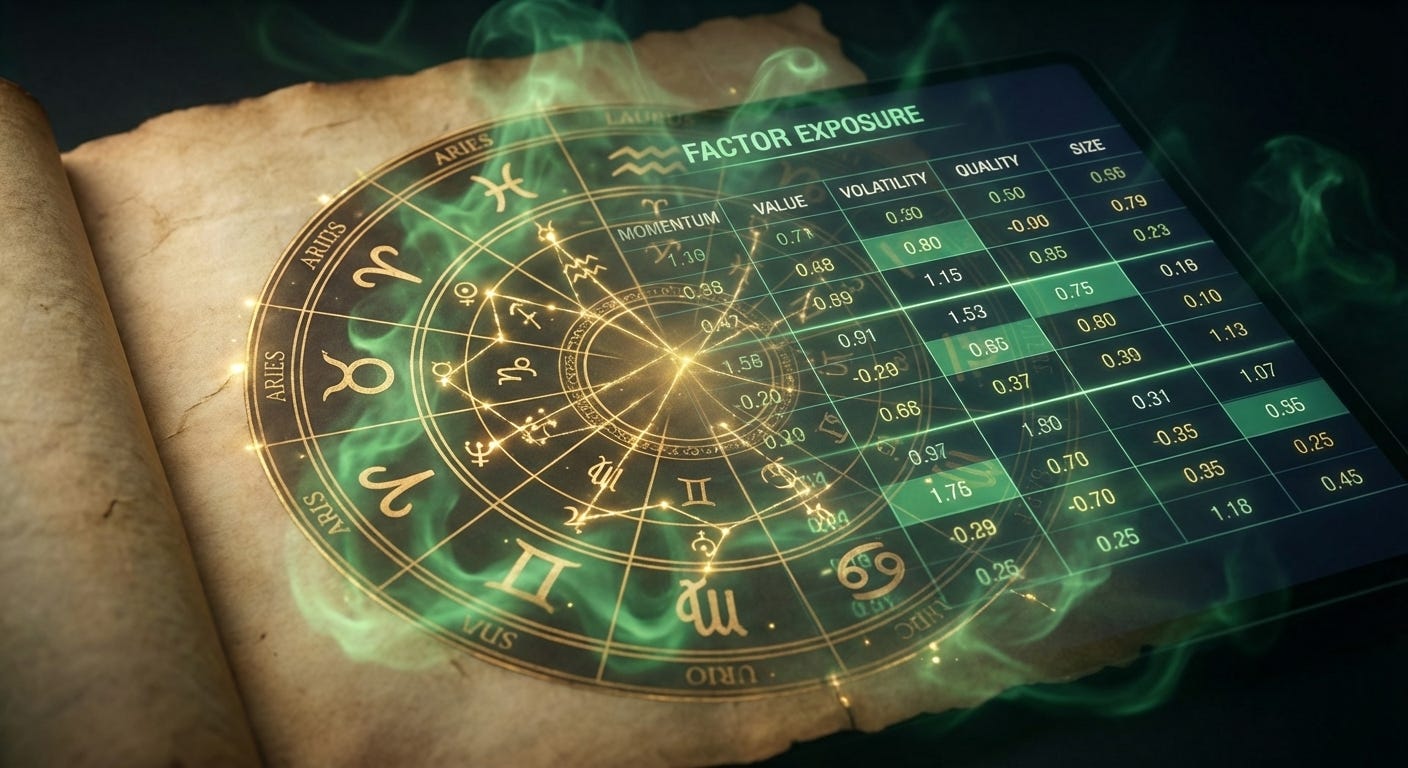
Now look at a factor-based risk model where you have multiple factors. Each represents a type of exposure like market beta, volatility exposure, sector concentration, liquidity risk, momentum, value, size, etc.
Then you have the positions in factors and correlations between them. How much exposure do you have to each? Long volatility or short? Overweight tech or underweight? High beta or low? How do they move relative to each other? Do they amplify or offset? Financial modes and astrology map these relationships obsessively. Finance bros are astrology girls, hello, duh.
You have time-specific inputs, current market conditions, entry point, moment of the trade, and then you interpret them - given these exposures and relationships at this specific moment, here’s your probability distribution for the future.
Both financial models and astrology as systems are the same structure saying that the arrangement of these elements relative to each other, at this precise moment, determines what happens next. Both take chaos and force it into a grid of positions, factors, and relationships. Both promise that if you understand the configuration correctly, you can see what’s coming.
The astrologer asks where Mars was when you were born. The quant asks what your volatility exposure is. Both believe the arrangement determines what comes next.
Cardano wasn’t doing two different things when he calculated dice odds and cast horoscopes, but his intellectual descendants kept the math and pretended to drop the magic to rename it “quantitative risk management.”
Drawing cards & conclusions
Finance bros aren’t doing astrology with Bloomberg terminals as a metaphor as they’re doing exactly what Cardano did by interpreting randomness within bounded structures, forcing chaos into grids, and believing that the arrangement determines what’s next.
Cardano calculated the odds and cast his lot with the stars but he saw no contradiction because there wasn’t one. Both astrology and probability were attempts to make chaos feel readable.
Four and a half centuries later, his intellectual descendants run Monte Carlo simulations (named after a casino, another gambling nod) on Bloomberg terminals (which are horoscope generators) and believe they’ve left the mysticism behind.
My guy, they didn’t leave anything behind, they just renamed astrology.
In Part 3, I’ll tell you what happens when the stars don’t align because the Oracle at Delphi inhaled fumes from a crack in the earth and spoke prophecies vague enough to never be wrong and trading gurus are just priests at Delphi with Discord servers. When it all collapses, the oracle never admits the system failed.