

If I’m being honest and ask myself whether I’ve ever truly madly deeply fallen in love in my life, the only answer I can give is no, not yet, I don’t think so, but I came close to thinking I felt it seemingly twice, the first time with a Frenchman and the second with a Dutchman.
The Frenchman I met on Tinder, which is somehow embarrassing, but not as embarrassing as the fact that he had a married girlfriend he was smitten with when we met (he didn’t tell me until later, obviously, because no one ever does, and by then, it was too late for me as I had been hypnotized by the fornicating). She was manipulative, married and knew how to market martyrdom unlike any other - she even gave him a ring, had him regularly traveling long distances to see her, everything always on her own terms of course, a real power move situation, you know how this goes, right? He was spellbound, and in between all of this was yet another third party in the form of a second Frenchman I was involved with (whose name I couldn’t pronounce) basically for 75% of the time of this situation, all in a half-hearted attempt to forget the first Frenchman (who encouraged me to do the second Frenchman thing as much as possible). It was everything you wanted a ménage à trois to be except it wasn’t satisfying, so it’s kind of a bummer that it truly never worked out between the original Frenchman and his married girlfriend because all these years later you’d want a real love story to come out of all that pain, right? But maybe the mid Belgian makes him happy. I hope so. Also, I actually don’t know who she is, but she’s Belgian, so she’s mid, unless she’s a DJ (sorry, I don’t make the rules).

Anyways, the second was a Dutchman who I met because he literally walked into me at a bar, which, for context, is basically the height of romance in the Netherlands, no pun originally intended (though after I wrote it out, absolutely). On average, Dutch women are 170cm (5’7”), American women are 162cm (5’4”), and moi, I’m 168cm (5’6”), but none of these numbers matter because in the Netherlands you are short regardless and everyone’s eyeline is above your head and you get used to it and you wear high heels whenever you go biking to ensure you stay upright. The Dutchman was a bit more simple than the Frenchman situation because all that happened is that he walked into me at a bar by accident, said something in Dutch (which I didn’t speak a l’epoque natuurlijk) to me and since I’d had 2 drinks already, I just replied ‘Nice to meet you. You’re very attractive, you know.’ And that, reader, is how years of my life spent thinking about a person came to be.
Both ended as disasters, of course, and I had no business being anyone’s anything given my immaturity, of course, but looking back at it, I don’t think I was ever truly in love with either man as much as I felt in love with the possibility of one day falling in love with either considering us as an entity together. Yet I felt that potential because I can honestly say I did love their personalities and personhood, warts, good, bad, and ugly, this whole mess, so however much I idealized them and then found them to be human all too human and disappointing - frankly, even when things ended, it truly felt like someone died. I was devastated. It was unbecoming. I don’t think I have that much moisture left in my body anymore but god, I wept openly on the streets both times.

Now here’s the thing that matters for this essay that has a very joyous start to Valentine’s Day 2026 (not): funny enough, I ran into the Dutchman ages later on Bumble (when I was still living in the Netherlands). And reader, goodness, his profile was of someone I absolutely would not have swiped right on. Ever. If it had not been for the circumstances of how we actually met, the whirlwind of it, the physical reality of the charm of it all, of sitting on a swing outside a bar while making out with a man who literally collided with me in a bar in Amsterdam, minutes earlier - well, no. Never. He would have been another face I swiped past late at night on yet another rainy day in the Netherlands where everything fades to gray from dusk til dawn.
Do you know what that means? It means a relationship that came closest to love in my entire life so far would not have survived the filter of a dating app. If the Dutchman hadn’t walked into me at a bar and had simply been a profile I swiped left on, I could have saved years of my life, my love, my lament, and most importantly, years of my time! But no, that didn’t happen, I met him in person. The app would have killed it before it started. And that, reader, is the entire argument I’m about to make.
After all, haven’t you heard the news about dating app fatigue? It’s so over since we’re so back. Everyone you know has said it: dating apps are over. Dating apps don’t work. Dating apps are where battered egos go to get validation and then wilt into incelhood or findom or whatever.
The feeling is correct, but nobody has the right language for why exactly (notwithstanding Phil Collins feeling what’s in the air), and feelings without frameworks are just vibes. Vibes don’t survive contact with reality (see: every situationship you’ve ever been in), so what do we call it? Like Heidegger’s quest to make sense of the meaning of being, but far less lofty, what you’re experiencing on dating apps has a name in financial economics called market failure.
Specifically, a secondary market failure. Dating apps are secondary markets, which is a term for exchanges where previously issued assets get resold and recycled. Secondary markets have known failure modes that economists have studied for decades. Those failure modes have predictable consequences. And those consequences have a causal chain: the market rots from the inside, good participants leave, trading moves off-exchange into unregulated territory, and what you get in that unregulated territory are zombie instruments that look alive but aren’t. Every step of that chain maps onto what’s happening in dating right now, from the apps to the situationship you’re in to the reason nothing you do seems to make it move. The playbook ends exactly where you most likely are right now, which is possibly alone on Valentine’s Day or in the bed of someone who won’t fully call you their partner. Of the first two possibilities, I’m not sure which is worse. I’d rather be alone, just like Alice Deejay divined in 1999.
Here’s the plan. First, I’m going to explain what a secondary market is and why dating apps are one. Then I’m going to show you the specific financial mechanism that’s been degrading them since inception (spoiler: it won a Nobel Prize). Then I’m going to show you where trading goes when the market breaks, which is off-exchange, which is situationships, and why the one you’re in right now is a zombie company surviving on cheap credit. Then I’ll tell you the one thing that kills it.
I. Download
If you thought redownloading Hinge to get back on the dating apps meant you were inevitably dealing with damaged goods, well, no, let’s reframe, what you’re dealing with is a secondary market, so let me explain.
A primary market is where assets first get sold to the public. That’s the IPO, the initial offering, the moment something enters circulation for the first time. When a company like Airbnb goes public and sells shares for the first time, that’s a primary market. When you buy a new car off the lot from the manufacturer, that’s a primary market. When a developer sells a condo in a building they just finished, that’s a primary market. You’re the first buyer, the asset is fresh. You know its full history because there is no history yet.
A secondary market is where those assets trade after that initial issuance. The stock exchange where you buy Airbnb shares from someone else who already owns them? Secondary market. A used car lot? Secondary market. Zillow listings for that same condo three years later with “minor cosmetic updates” for a “charming” place that may or may not be concealing water damage? Secondary market. The asset has been previously owned already, which means the information is asymmetric in that the seller knows more about what they’re selling than you know about what you’re buying. You’re working with whatever’s been disclosed, which is not always everything and honestly (just like getting involved with a Frenchman, I’m just saying). Now apply this to dating.
In dating, primary markets are organic meetings through friends or work or whatever. A friend’s dinner party is as much of a primary market as a Dutchman literally walking into you at a bar is a primary market. They have original issuance, fair price discovery, and actual context for you to get to know the asset you’re dealing with directly. In other words, it’s the equivalent to a real human standing in front of you whose vibe you could never have extracted from a 500-character bio and three badly taken photos.
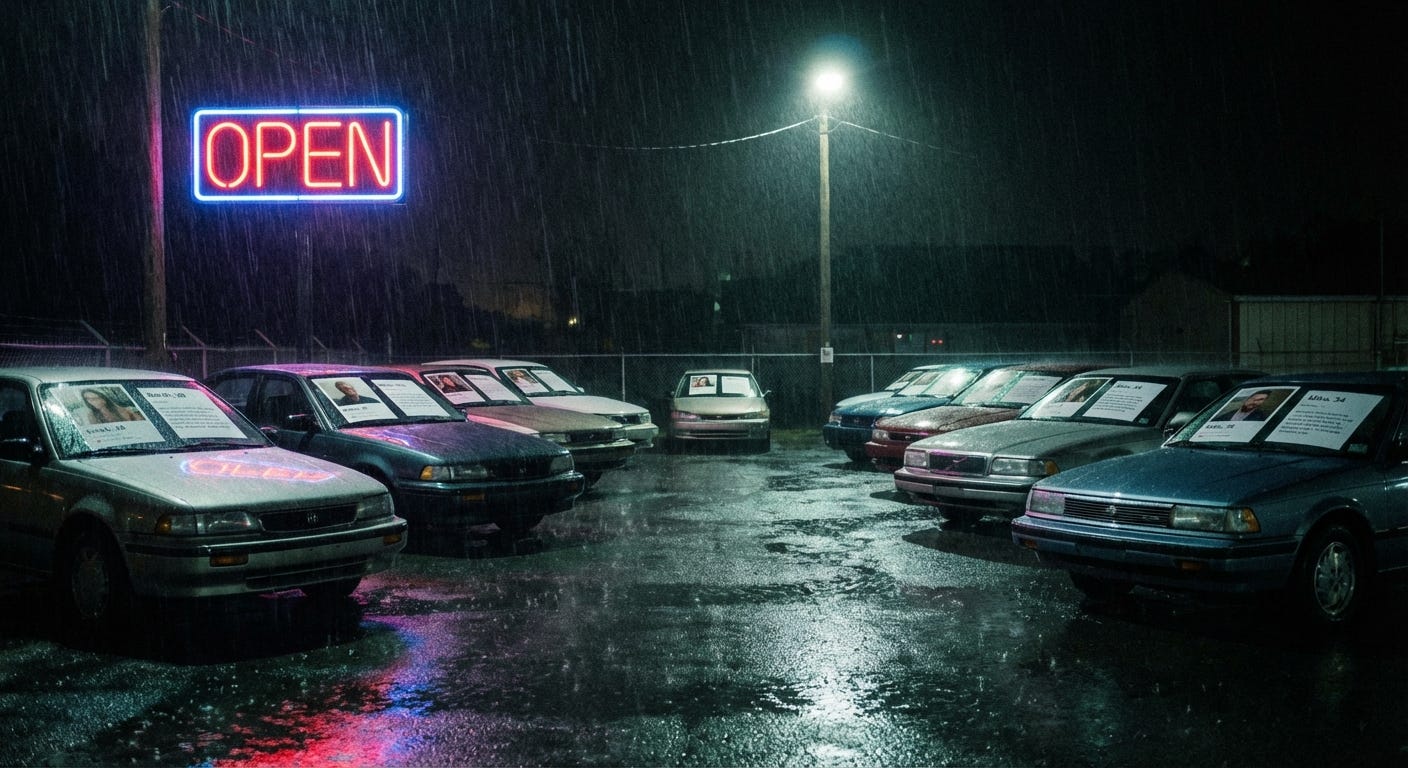
In contrast to a primary market, a secondary market is where assets trade after that initial issuance. They are, in Daft Punk voice, resold, recycled, marked up, marked down, traded between, all of this exchanged by people who weren’t there at the beginning and don’t know the full history of what they’re buying. That’s dating apps in a nutshell with their recycled inventory, previous investors’ leftovers, photos from 2019, heights rounded up by two inches if not three, and a universal agreement to pretend this is a functioning marketplace when it is, in fact, a lemon lot at best. I’m being charitable here because the Dutchman’s Bumble profile proved it. The man I almost loved was, on the secondary market, indistinguishable from the men I’d never look at twice. Yes, it gives me shudders to think about it. I spent years of my life - years - yearning for someone whose profile description simply read ‘passionate about positivity’. At times I think if I discovered his profile earlier, it would have knocked me into sense far more quickly, to be honest.
When I say a lemon lot, I don’t mean the kind on a Dolce & Gabbana majolica print dress, I mean the kind of defunct or broken down thing that should not be on the road or in your bed. Of course, the lemon lot mafia is aware of this, given that several of the most popular dating apps in the United States are owned by Match Group. That means every time you quit Tinder in frustration and download Hinge to find something more palatable or seemingly serious, you are migrating between products in a single corporation’s portfolio. There is really not much market choice - you will have the lemons, and you will like it. Match’s dominance in this area means they have you hook, line, and sinker. Imagine breathlessly storming out of a Zara and going to Massimo Dutti to cool off. Joke’s on you, house always wins, it’s the same parent company. Just like how all the same apps seem to have the same people being the same but presenting differently is the environment for this sameness to flourish to begin with.
II. Smothered Hope
Have you ever felt like you were in a Kafka-esque nightmare if you’ve returned to dating apps after a long time and you swore you’ve seen this person somewhere before? Well, it’s not just you (though screenshots help to remember). If you want to understand why your dating app matches are terrible, consider an unlikely source: an economist’s 1970 paper about used cars that won him the Nobel Prize. George Akerlof’s work showed that in any market where sellers know more about quality than buyers, the market degrades over time. That’s because the quality picks - as in the good cars - leave (owners keep them or sell to friends). Yet of the choices left, the bad cars, well, that’s what’s here to stay. Buyers can’t tell the difference, so they offer average prices. As good car owners refuse and exit, quality drops, and more and more good cars leave. Eventually the market is all saturated by all the bad cars, colloquially known as the lemons.
On dating apps this plays out with the precision of a Swiss watch that nobody asked for. Good partners find relationships and leave. Bad partners can’t maintain relationships and stay. New users encounter the lemon density, get demoralized, and either leave (depleting volume) or lower their standards (degrading norms further, which is how you end up on a date with a man who tells you he’s “not really into labels” before the appetizers arrive). Only 11% of users say their app is “good at matching them.” 45% feel more frustrated than hopeful.
Tinder lost 594,000 users in the UK alone in one year. Bumble lost 368,000. More than half of Gen Z reports feeling burned out on the apps. The good money is leaving. There’s an economic principle called Gresham’s Law that says bad money drives out good, and this is Gresham’s Law executing on schedule, which honestly makes it worse because it means the math was always going to do this. The apps were structurally destined to degrade. You just happened to be swiping while it happened.
So the secondary market is broken and the lemon problem is accelerating. The question is: what happens next? In financial markets, when an exchange fails, trading doesn’t stop. It moves off-exchange. Dark pools, private deals, no clearing house, no standardized contracts, nobody regulating anything. The alternative is not trading at all and humans don’t do that. In dating, the off-exchange equivalent is the situationship. About half percent of aged 18 to 34 have been in one. A peer-reviewed study on situationships, out of Baylor in 2024 found they feature the same behaviors as committed relationships but with lower satisfaction and almost no conversion rate into anything real. That’s not a relationship category. That’s off-exchange trading in a failed market. And the instrument it produces has a name.
III. Dead Lines
A zombie company is a firm that generates just enough revenue to service its debt but not enough to pay it down. It is like many people roaming amongst us alive but not alive, sustained by interest rates so low it’s cheaper to keep refinancing than to force a reckoning. Japan has been studying this for thirty years. After their bubble burst in 1991, banks kept lending to insolvent firms rather than recognize losses on their books. This resulted in a generation of zombie firms absorbing capital that could have gone to something viable, blocking new market entrants for decades.
A late-night text here, an Instagram like there. A “we should hang out soon” that has no date, no time, no specificity. This is a zombie company in human form which generates just enough revenue to service its debt. The modern minimum viable product of human intimacy is a story tapback reply or a meme at 1am. The subprime instruments of modern romance are low-cost, low-effort, and high-volume, accordingly requiring no collateral whatsoever.
Even worse still, zombie firms don’t just fail to die. The Bank for International Settlements found they actively prevent healthy companies from forming. Every dollar lent to a zombie is a dollar not lent to something viable. Every hour spent decoding a text is an hour not spent on someone who would make plans on a Wednesday. The situationship doesn’t just waste your time, it destroys the future by crowding out the possibility of something that works. There is some good news though. After 20 something odd years, the Bank of Japan finally raised interest rates in 2024. Twenty-five basis points, a quarter of one percent, and zombie bankruptcies surged 13% year over year. That’s all it took. A tiny increase in the cost of capital and the things that were never alive started dying for real.
The equivalent of raising rates in a situationship is asking “what are we?” One small, reasonable, twenty-five-basis-point request for clarity. And the thing collapses instantly because it was never viable. It was only ever surviving on cheap credit. A willingness to not ask is the low interest rate, and the moment it is withdrawn, the entire enterprise files for emotional bankruptcy with its read receipts still on.
So that’s what a situationship is: a zombie company. Yet how is it dealt with, how does knowing the diagnosis somehow seemingly still not cure the disease?
IV. Love
The apps are a secondary market in structural decline where Gresham’s Law drove the good money out, the lemons stayed, and the lemons won for survivorship bias. Trading moved off-exchange, into situationships, where zombie companies survive on cheap credit and your willingness to not ask questions. Your situationship is a zombie company with no business plan and you keep refinancing it because the alternative is recognizing the loss. But do you know something cool?
The whole thing about Valentine’s Day is that the true story behind it seems to oft get forgotten: St. Valentine was beaten with clubs and beheaded for performing illegal marriages. The Catholic Church couldn’t even verify which martyr they were honoring, so they put a kibosh on the Valentine feast day in 1969 due to insufficient due diligence. The patron saint of love is defined by execution and the holiday named for him lost its own regulatory approval. Yet the commercialization and importance of this day through inflation means things changed because the market for how to deal with St. Valentine itself also changed. Now it has become the market itself.
Our key lesson to take away from this transfiguration from martyr to money making palooza?
Raise your rates. Even a quarter of a percent. Watch what dies. Give change a chance. Try a new marketing campaign. There’s always more options around you than just merely what’s in front of you on your screen.
Happy Valentine’s Day!
Reader note: For comments/consulting inquiries, reach me at ani@anibruna.com. An obligatory message to like and subscribe follows: Like and subscribe for updates. If you do not like it, tell everyone immediately by sharing this link. Merci’
You are an absolutely brilliant writer with an uncanny ability to connect pop culture with market references. In an era of AI slop, you are a shining light of originality
I love this. Very well written and totally agree!