
Neither a borrower nor a lender be, unless your rival is GPT: to understand the AI economy, understand Shakespeare
It is possible the stupidest person you know can't close-read, but they can raise a Series B: on Shakespeare, rizzlers, and the AI trade.

Reader note: in an effort to challenge myself as a writer, I am considering a series of mini essays at 1000 words tops. This hurts me deeply and I resent it. I am not responsible for reactions to this.
“...Neither a borrower nor a lender be; for loan oft loses both itself and friend, and borrowing dulls the edge of husbandry” — Hamlet (Act 1, Scene 3)
The English, one of the most neurotic and repressed peoples on Earth, responsible for great art and even greater paparazzi car photos, spent centuries perfecting the art of not saying what they actually want, which turns out to be the core competency of the cultural moment we’re in, as I keep thinking: to understand the AI economy, you need to understand Shakespeare.
To understand Shakespeare, you need to know how to close-read. To close-read is to remember that words are not just information; they are indications of what people do to one another without saying it directly.
I quote Hamlet to introduce a line about how you shouldn’t lend to friends and family, as the expectation of repayment strains everything, yet the AI economy is literally these expectations inverted, written by a cast mixing friends, family, and outright rivalries. Every time something AI related pops up in the news lately, I just think to myself: god, this is all so Shakespearean.
Amid the online discourses on taste, literacy, and technology, I also fear the worst timeline has come true: the kids who read the room but never read the actual book have taken over the world. They did jostle to read the part of Romeo out loud, but the people who run on vibes, god bless them, have not thought deeply about what they are doing. And it shows. Oh god, it shows.
Instead of reading, the rizzlers of recess rode the warm-intro pipeline from sales development to Head of Something Something, and they may be in the AI trade now. If I were to lack charity, I’d say it is entirely possible that the stupidest person you know has excellent executive presence because their intelligence is in reading other people in the moment and navigating those chapters without any questioning.
These are decision makers whose incuriosity scaled by learning to read performance as reward through discarding subtext at the door entirely. It worked beautifully socially and spectacularly professionally. The same person who could riff through a class discussion without reading but hamming it up to perform the part of Romeo to the crowd’s cheers is the adult who can repeat the line, sell the line, build a deck around the line, and never ask who wrote it, what it leaves out, or what happens next. These skills aren’t worthless, they are very necessary (imagine all the bitter nerds going on about their special interests over the watercooler), but these skills alone are not sufficient. The problem with accepting everything at face value is that the winnings go to you and your tribe, but eventually, if you’re good enough, word gets out, someone puts a valuation on it and your people take it further than anyone imagined, or they fuck around with impunity until found out and the consequences never stay forever in-house.
Close reading is the refusal to accept a fluent performance at face value by critically considering what drives the work and why. It requires you to not react to words but dig deeper into the context and characters to chart this understanding of the abstract why by breaking the work into questions, for example, asking who is speaking to whom, what they want, what is known, what is said, what is not said, and what actually happens after all. Close reading and the curiosity driving it is beyond just words, of course. We are seeing what happens when the people who never asked those questions are handed the machinery that writes the AI story with implications for all society now.
To understand the AI economy is to understand what is said and how it’s written through business mechanisms. Two recent filings via the SpaceX IPO and the OpenAI/Apple IP alleged theft debacle show there’s more than money going round in loops - competitors are becoming one another’s landlords, or partners in one business line while plaintiffs in court. Per SpaceX’s filing, Anthropic will pay $1.25 billion a month through May 2029 for Colossus compute; Google will pay $920 million monthly from October for about 110,000 GPUs. The same filing names both as Grok competitors, calls the capacity “unused,” and gives the parties 90-day exits after December. Billions in revenue rests on relationships between resentful rivals.
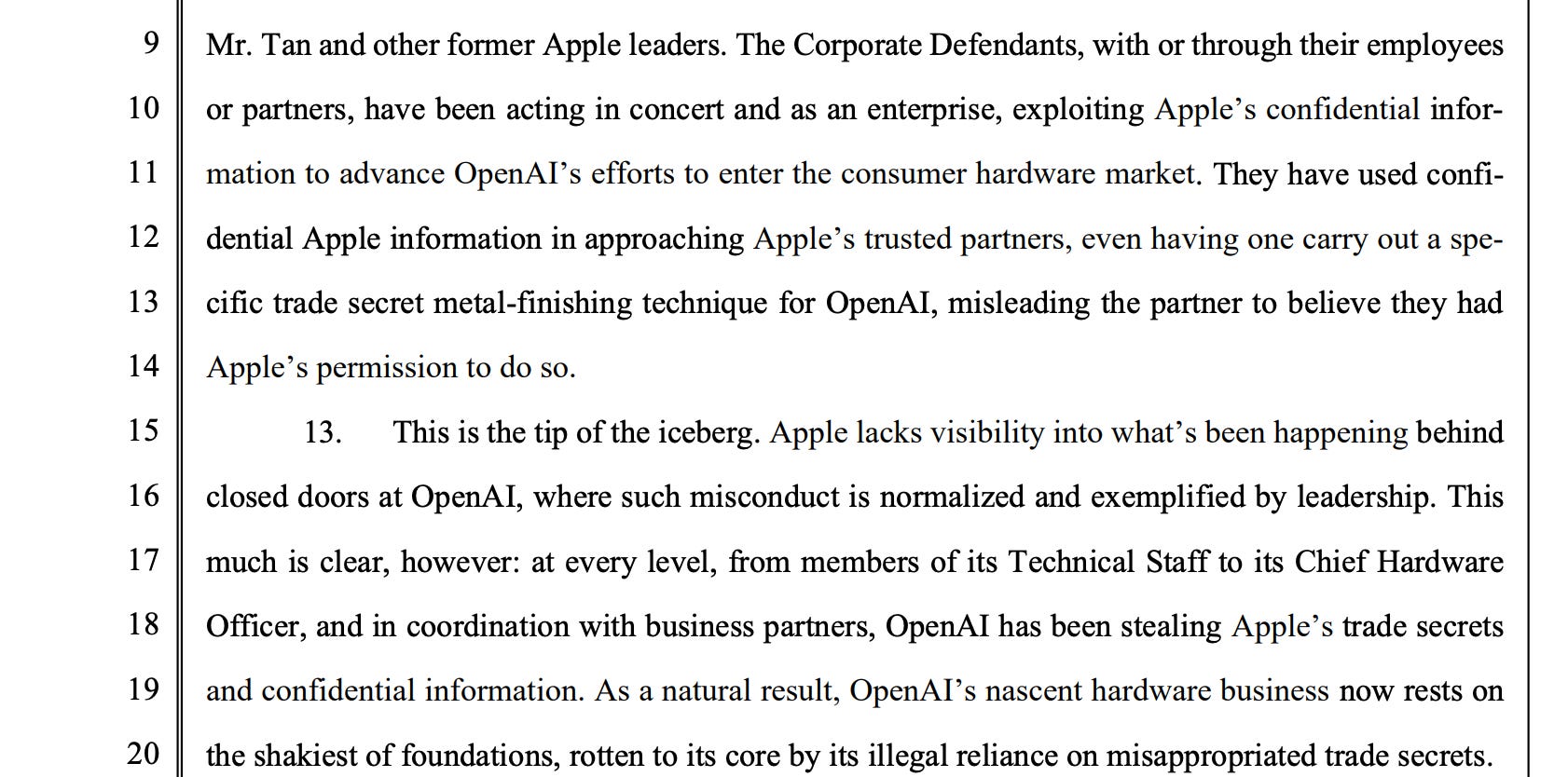
Shakespeare would’ve loved the set-up given the cast where Google is at once SpaceX’s customer, its investor, and its model rival, while Anthropic is at once an OpenAI offshoot, an xAI rival, and xAI’s biggest tenant, and Apple is at once ChatGPT’s distributor, reportedly Gemini’s adopter, and OpenAI’s plaintiff (simultaneously preserving their partnership for an integration agreement).
The business enemies to reluctant lovers arc is nothing new in business - railroads pooled ownership, telecom firms sold unused fiber to competitors, and currently the Japanese ice cream cartel is allegedly colluding in price hiking. What’s new with the AI economy is the collaboration inherent to its ecosystem. Capital circularity is compounded by compute dependency compounded by talent genealogy and all this scaled through distribution.
That complexity and its considerations echo Shakespeare’s classics. In the Merchant of Venice, Antonio needs capital from the rival he abused. Macbeth hears a forecast of his valuation and engineers it through deception to become true. King Lear hands over the kingdom to the best pitch, and Hamlet’s Polonius is a double agent fraud uttering truths while running an intel operation.
And the one villain to rule them all, god. Iago would have had an incredible career in venture capital. It is an absolute shame we’ll never see what he’d do to make the Forbes 30 Under 30 list.
Iago does not simply lie: he understands that if you put the right object in the right scene with the right people, somebody else will write the story for you through their projection.
Literature cannot shield you from failure, it doesn’t make you smarter by itself, nor can it forecast markets, but it can illuminate how pride, grievance, scarcity and more impact the calculus from what’s said to what’s actually driving the show. With the AI economy, the one thing I am certain of is that there’ll be a Netflix limited series at some point.
Reader note: For comments/consulting inquiries, reach me at ani@anibruna.com.
Disclosure: Definitely not financial or legal advice or allegations, just vibes. An obligatory message to like and subscribe follows: Like and subscribe for updates. If you do not like it, tell everyone immediately by sharing this link. Merci.