
Peace sells, but who's buying? The unprecedented American financial kill-chain playing out in front of your eyes right now in Iran
Introducing a brief mini-series on what I'm calling the American financial kill-chain happening in real time in front of our eyes in Iran

“Can you put a price on peace?
Peace... Peace sells...
Peace... Peace sells...” — Megadeth, “Peace Sells... but Who’s Buying?” (1986)
We live in unprecedented times, in case you forgot from the pandemic, but when I say unprecedented, I mean read these next few words very carefully because you and I are witnessing in real time how the United States of America has just pioneered an unprecedented new chapter of modern warfare that I am calling the financial kill chain.
Never before in history has an American governmental official admitted openly to the public engineering step-by-step a dollar shortage to collapse another country’s currency that has led to people protesting.
This was not a leak, not a classified briefing surfaced by an investigation decades after the fact, but a public embrace of military doctrine through financial mechanisms that has previously chiefly fueled fodder for academic careers, conspiratorial Reddit posts, and the high brow version of both which is the same thinking stamped with a think tank’s seal of approval.
In early February, Scott Bessent, the Treasury Secretary of the United States, sat smiling in front of cameras at Davos, and then under oath before the Senate Banking Committee, and explained in sequence how America broke Iran’s financial system through financial mechanisms, watched its currency collapse, watched its banks die, watched its bazaars shut down, and watched its streets fill with people who could no longer afford bread though the part we all watched involved seeing the body bags of protestors killed by their government. Bessent called it “economic statecraft, no shots fired” though twenty-three days after his Senate testimony, on February 28th, the United States and Israel launched Operation Epic Fury which killed Iran’s Supreme Leader Ali Khamenei, his daughter, a grandchild, the IRGC Commander-in-Chief, and the Chief of the General Staff,.
This type of public admission by a senior American official has never happened before, and the thing I’m certain of is that the United States has executed a sequenced financial-to-military kill chain and documented it in public. The thing I’m uncertain of at this moment is whether pulling this trigger has started a feedback loop that undermines the very dollar system the financial phase was designed to protect.
That’s what this series is building toward, but I think first we have to understand how the weapon was built. Part 1 here is the essay introduction to a brief mini-series where I’ll trace the financial kill chain phase by phase, and to do this properly, I want to introduce the context setting-up the series in this post.
1. What is a kill chain? Not a derivative of Hot Topic
For those not familiar with a kill chain, it is not a store for mall goths, but military doctrine also known as the F2T2EA model to find, fix, track, target, engage, and assess. This is the sequence a military follows to destroy a target and an ethnic mother uses to track her children’s life movements. Every defense analyst, like every first generation American, knows it.
These are sequential phases that culminate in destruction or whatever the kill chain’s heart desires, but my point here is that this is unprecedented in that this kill chain logic from military doctrine now applies to financial warfare. It is a documented operational reality right in front of you in publicly available Senate testimony and Davos interviews and Treasury press releases. This is no longer the stuff lurking in the shadows, alleged and unconfirmed, and none of these elements are new on their own. Of course dollar weaponization has precedent, of course sanctions preceding military action has precedent, of course economic destabilization as regime change strategy has decades of precedent.
What has zero precedent is these three things happening simultaneously and admitted to as the integration of military financial doctrine, which is what we are witnessing.
The financial kill chain sequencing for Iran was deliberate and it was designed like dominos falling.
What I’ll call the bank-to-bombing pipeline looks something like this: first sanctions dry up dollar inflows, then dollar shortages kill zombie banks that had been technically liquid, this in turn leads to bank collapses forcing the central bank to print, that printing itself destroys the currency, the currency collapse shuts down the bazaars, and that’s what leads a populace out onto the streets in protest when everything is broken and bread can’t be brought. Every domino was placed with the next one in mind, and if you think that’s a metaphor, Bessent described this exact causal chain on camera and then repeated it under oath. It goes without saying that this financial kill chain pattern was also replicated in an earlier draft in January when U.S. special forces pulled Nicolás Maduro out of Caracas after a decade of escalating sanctions, entity designations, and the targeted financial strangulation of Venezuela’s state-owned oil and gas company.
This financial kill-chain playbook has happened in rapid succession barely two months into 2026, though one wonders if the third time must be a charm and who that may involve.
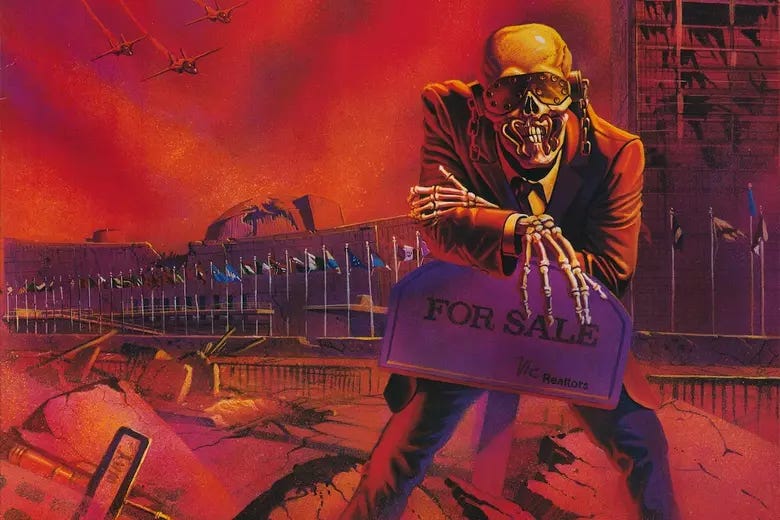
Photo credit: Album artwork by Ed Repka for Megadeth’s Peace Sells... but Who’s Buying? (Capitol Records, 1986)
2. A history of violence: America’s policy of truth
Every previous instance of American financial warfare preceding military action required decades of declassification to piece together because that’s how this was always supposed to work, because no one says it happened the way it happened as it was happening. Blatantly admitting to it is unprecedented considering the course of history. You do the thing, you deny the thing, you classify the thing, and then historians reconstruct the thing from document dumps thirty years later.
Consider how Nixon told CIA Director Richard Helms to “make the economy scream” in Chile in 1970, and we only know this because the Church Committee surfaced Helms’s handwritten notes five years later, though the full picture took decades of declassification after that. The capital flight engineering, trucker strikes, credit strangulation, all of it covert and denied in real time, like a first generation (or really, any child) lying to its mother about eating the cookies or brushing their teeth. Consider how the CIA’s Cuba destabilization program, the sabotage of sugar exports, the destruction of Havana’s European banking relationships, stayed classified for decades. Consider how Madeleine Albright’s “worth it” on 60 Minutes in 1996 - when Albright was asked whether the deaths of half a million Iraqi children from sanctions had been worth it and she said yes - was a gaffe she spent her career trying to take back.
Bessent is not taking anything back, Bessent is not covert, Bessent is in your face telling you about the American financial kill-chain and I repeat: this is unprecedented.
3. What is the price of peace and what is next? When bombs and banks go hand in hand
Can you put a price on peace? It’s priced into a collapsed currency, 72% food inflation, seven million depositors who woke up one morning to find the signage ripped off their branches, bazaar merchants and crowds of protestors on the streets in the thousands while regime insiders led capital flight through wires of everything they had to Dubai.
Bombs and banks go hand in hand in the financial kill chain, and what comes next is anyone’s guess.
As of this morning, March 2nd, markets opened with oil spiking 13% before settling around 8% up with Brent crude, the global benchmark, pushing toward $80. The Strait of Hormuz is functionally closed as one hundred and fifty tankers are anchored in open water and the Iranian Revolutionary Guard Corps (IRGC) is broadcasting on maritime radio that no ship may pass. Iran’s retaliatory strikes have hit Dubai, Doha, Kuwait, Bahrain, and Riyadh for three consecutive days and seem to be targeting the five-star hotels, not the Ibis or Holiday Inn, which is some form of consolation, I guess? Debris from intercepted missiles has damaged the Burj Al Arab and commercial operations at Dubai’s airport, the world’s busiest international hub, have been suspended since Saturday when the strikes began. Iran’s Foreign Minister said the military has partially lost control over its units and analysts saying $100 oil if the Strait stays blocked. The volatility index is up 18%, gold is near $5,400, and my Substack remains free.
I want to remind everyone that a stoned metalhead from southern California asked a prescient question forty years ago that opens up this series: peace sells, but who’s buying?
Scott Bessent can answer that, as he went on television and told you the price and twenty-three days later, a war has been bought with it.
Stay tuned for part 2, where I begin to explore the parts and pieces of the financial kill-chain.
Disclosure: Definitely not military, financial, or legal advice or allegations, just vibes. Contact me at ani@anibruna.com
Like and subscribe for free to receive new posts and support my work bla bla blaIf you want to read more writing.
Here is the obligatory message to like and subscribe for updates or share with everyone if you hated it. Merci