
The art of the blacklist: how to be a professional hater, pt. 2
On enemies, billionaire beefs that prove the Italians were visionaries about hating, and why you should break-up with your girlfriend

They say to write what you know, so if I’m writing about professional haters, I should probably be one. I recently discovered how some of you have been reading every single thing I’ve written since I started and have contributed absolutely nothing via support of some sort in sharing or pledging. That’s fine, since this essay is about what happens to people like you historically. A paywall will be incoming in the future, but for now, a continuation on how to be a hater.
In Part 1, published on the anniversary of Julius Caesar’s death, I explained why I want an archenemy, why you should break up with your girlfriend to a rhetorical gentleman reader, and how modern billionaire beefs are vendetta infrastructure projects hearkening back to the ancient Romans, except now there’s an unprecedented technological component. If you haven’t read it, go back and do so on X so I can get some sweet, sweet Elonbucks (I don’t actually, but that’s another story), or just trust me bro when I say that billionaire beefs are actually infrastructure projects and the Romans figured this out first.
As for the rhetorical gentleman reader in question, I haven’t theoretically snooped on their social media in ages, which means this invisible man has effectively been delisted from my attention, and if you know anything about proscription by now, you know that being removed from a blacklist entirely is somehow worse than being on it. At least the enemies of ancient Rome knew they mattered.
A quick reminder as it’s been 2 weeks since the first post: proscription was the Roman word for when hatred becomes procedure through authorized decrees. It’s animosity conjured into administrative measures, vendetta deployed like software as a service, except instead of business to business, it is person to person.
My thesis is that when a grudge goes from personal to professional, it becomes scalable and materializes into infrastructure. As you can see, spending time in the Bay area has impacted me, so it’s time to build, and we’ll start with Sulla who especially enjoyed building…blacklists.

Cyberpunk 2077 but make it Proscription 82BC
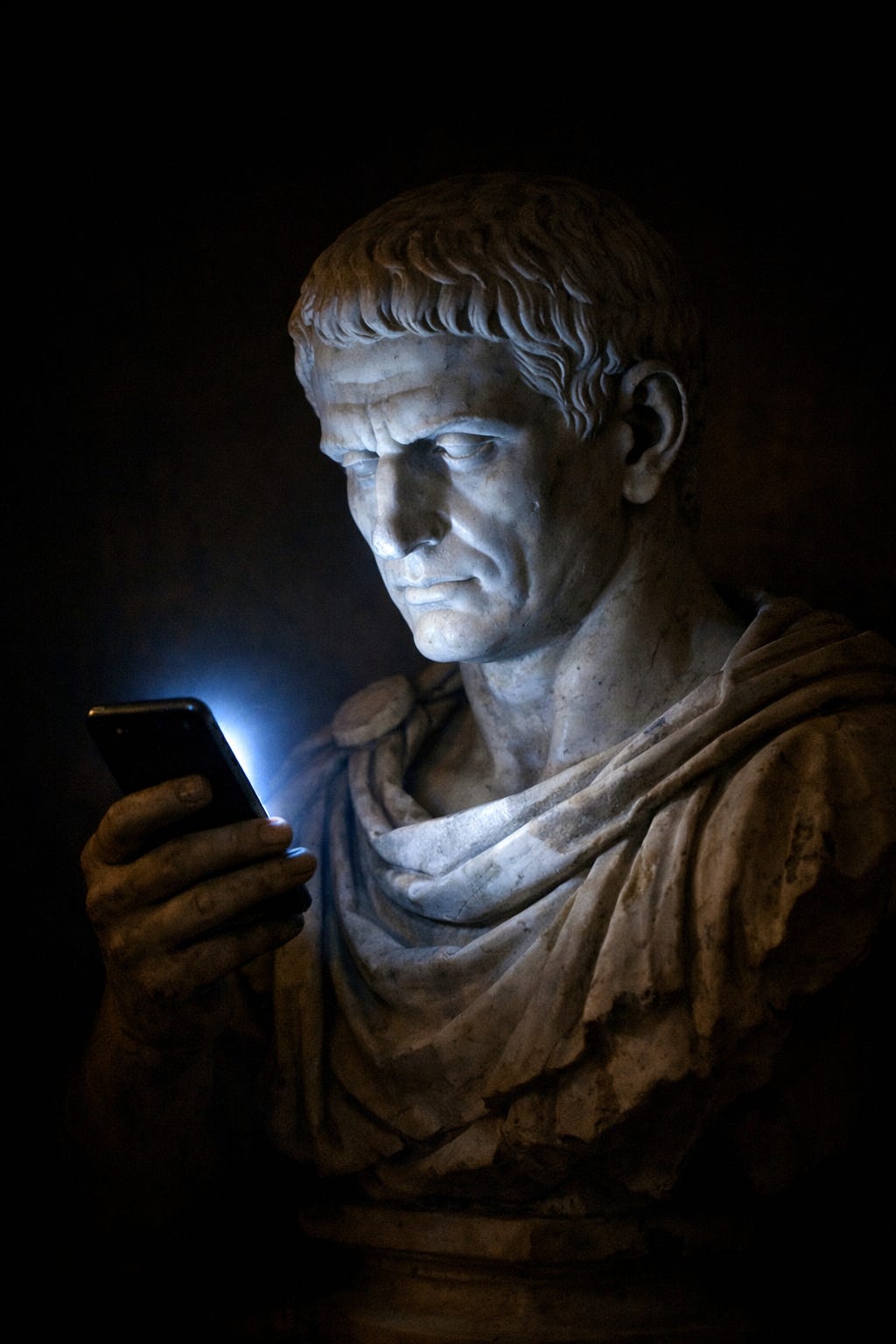
The TLDR Marvel villain origin story of Lucius Cornelius Sulla is that he had his military command stolen by a political rival named Marius through backroom political maneuvers involving legal decrees.
Sulla’s response to fight fire with fire involved being the first Roman general in the Republic’s history to march into Rome with his own army and weaponize legal decrees. I believe nowadays we’d call him a disruptor or contrarian thesis holder, but that’s how Sulla elevated merely being a hater into an actual system through posted lists and legal cover in the proscription system. That’s right - blacklists exist because of vindictiveness elevated into a formal government program.
Italian bureaucrats everywhere, raise a toast to Sulla, your patron saint of administration who made himself a roaring success after being personally betrayed by the political establishment. He decided if they were going to make murder political, he was going to make it administrative. Icon behavior
Much like how I declared myself Dark Empress of fintwit, Sulla made himself dictator once he achieved the ancient equivalent of a viral wave over Rome, and then he figured out how to turn political revenge into administrative procedure. That may be one of the single most dangerous things anyone has ever done with a grudge especially considering homeowners associations were not even a thing yet.
Sulla published names on whitened tablets in the Roman Forum and if your name was on the tablet, my guy, ya cooked, because anyone could kill you legally, your property was forfeit, and your sons and grandsons were stripped of civil rights. Per Plutarch, Sulla offered roughly 33 years of wages and the bounty was open to anyone, even for example a slave killing his own master. One wonders if this may have inspired the writers of the original Gladiator film.
Three lists came from this and totaled roughly 520 names, with the people on them ranging from senators, equites (the Roman business class below senators), and wealthy landowners. Up to 4,700 people died, massive amounts of property got redistributed to Sulla’s allies, and the Roman political class permanently lost its sense of safety. Borat would call this a great success because the system worked exactly as designed, but that is also the problem. Like absolute power, vendetta infrastructure always corrupts absolutely the moment someone figures out how to use it for something other than its stated purpose.
That someone was a man named Chrysogonus, Sulla’s freed slave, who I think of as the earliest example of a type of operator, and goodness, he would have crushed it in VC, I just know it.
The operator is the person who doesn’t make the list but understands the machinery well enough to exploit it. Chrysogonus figured out the arbitrage opportunity in proscription as a service: if you could add a name to the blacklist (effectively a kill list), you could buy that person’s property for next to nothing at the rigged auction afterward, because nobody would dare bid against you. So he had a man named Sextus Roscius illegally entered on the proscription list after the proscriptions had supposedly ended, and then bought his estate, valued at 6,000,000 sesterces, for 2,000. I don’t know what the contemporary equivalent of that is and I’m not going to look it up because I’m tired, sorry, but big numbers, ooooh. The list was designed for political enemies and it became a real estate tool because the infrastructure didn’t care about intent. Zillow but make it ancient Rome. If you were someone with a nice house, watch out because if your name got onto that list, everything was going to fall apart.
The blacklist evolved with history, for example in the 1500 years after Sulla how they continued in Italy with the Medici family. They understood that in a commercial republic, credit is control and denying someone money is the equivalent of a baseball bat to the knees. Across five cities, they coordinated quietly, rejecting to extend credit to enemies in a manner the Bay Area calls “stealth mode.” There was no formal procedure so the people targeted by the Medici found out when they needed a loan but couldn’t get one. You can’t sit with us but make it you can’t bank with us.
The Pazzi conspiracy was the turning point when in 1478, the rival Florentine banking family tried to assassinate Lorenzo de’ Medici and his brother Giuliano during Easter mass in a cathedral. They killed Giuliano but Lorenzo survived, and the Medici went scorched earth as they erased the name entirely. Anyone named Pazzi had to change it, buildings were renamed, coats of arms were changed, the whole dramatic 15th century shebang of it all as Netflix would dramatize it, you get the picture. 548 years later, incidentally, Pazzi is also the name of a wonderful pizza restaurant in Amsterdam.
Billionaire beefs that are actually infrastructure
Wealthy people building private systems imposing consequences absolutely did not stop with the Medicis, of course. The evolution of blacklists speaks to the multifaceted nature of them and how they’re wielded, which contemporary billionaire beefs continue to show us in various forms and functions. A selection of them for your enjoyment like a wine and cheese pairing but for spite in one’s heart:
Palmer Luckey was forced out of Facebook in 2017 after donating $9,000 to a pro-Trump political group three years after selling his company Oculus to Facebook for $2 billion. The donation and its social repercussions set Luckey on a trajectory that sees him now running Anduril and things like China personally sanctioning him. As of writing, Anduril is raising $4 billion at a $60 billion valuation. The man who was proscribed from Silicon Valley for a $9,000 donation now runs a company that tracks things in space, is building an autonomous weapons factory, and is opening up a bank (Erebor Bank) that just received a U.S. national bank charter. Erebor appears to be on track in part to provide banking services to businesses that have previously been denied financial access. It’s an interesting arc if you consider the facets of his story given that Luckey is building a parallel system where the blacklist doesn’t apply.
I’ll briefly note that there’s a racketeering lawsuit going on between Elon Musk against OpenAI heading to a jury trial April 27 with up to $134 billion in claimed damages. Litigation itself can be weaponized as vendetta infrastructure with discovery rules.
Some of you may have seen another beef in the form of short seller Michael Burry, who disclosed $912 million in notional put options against Palantir, and Alex Karp, the CEO. Karp called him “batshit crazy” on CNBC, Burry responded with a Substack manifesto (I respect the medium, obviously) and a metric he calls the “B/S Ratio,” which stands for Billionaire-to-Sales Ratio. Why blacklist when you can short sell is a philosophical inquiry I just thought of as I was writing this for which I feel very smrt. But yes, short selling could be a type of vendetta infrastructure that speaks the language of markets. You don’t put someone on a list. You put a price on their decline. That’s so fetch but make it institutional.
Then there’s Kalshi and Polymarket, two prediction market platforms fighting over who gets classified as “regulated,” and this is the part I find analytically the most interesting, that modern vendetta is often a fight over classification. Whoever controls the codes controls the consequences. Regulated or unregulated, sanctioned or unsanctioned, vendetta infrastructure is itself still in the purview of a higher bureaucratic power of some sort (until it isn’t, as witnessed by those who fly so high, they are above the rules now, to paraphrase a quote from Aunt Polly in the TV series Peaky Blinders).
All this said, perhaps the cleanest proscription of 2026 so far is that Texas billionaire Robert Marling donated $675,000 to oust Rep. Dan Crenshaw. This was all reportedly over a mask ordinance at a conservative youth summit originally. Consider how Sulla needed to march on Rome twice, the Medici built a banking network over generations, and Marling needed a wire transfer and a Tuesday afternoon to end someone’s political career through funding a rival.
X money gonna give it to ya, the algorithm as agony, and that girlfriend of yours you haven’t broken up with yet
On March 10, Musk confirmed that X Money enters public access in April. Remember how the Medicis did their thing coordinating across cities and banks? This is that turned into a product launch of sorts. Consider that via X, Musk is building the social graph, content platform, AI layer, and payment rails into one system. This means he controls over 500 million users, the distribution, the AI that recommends to them on the app, and starting soon, he controls the money in and between them. Elon has previously said “When I say payments, I actually mean someone’s entire financial life.“ Elon, if you’re reading this, I promise I’ll stop going to therapy when I get my book deal and student loans paid off.
Being banned from X already costs you your audience, but one wonders how the modern black list and the art of tweaking it may evolve. Chrysogonus manipulated lists to buy real estate but in 2026, I’m not quite sure he’d bother. I suspect that he’d understand a designation in one system propagates through vendor relationships, payment networks, procurement databases, and reputational intermediaries before any appeals, and somehow he’d end up at a seized sanctioned goods type of sale buying back a yacht or two for some Russian oligarchs.
I find the X Money thing most interesting to reflect on lately because it seems to reinforce the new iterations of ancient structures we’ve grappled with to mixed results. Consider how proscription systems in history were binary with someone either being on the list or off the list. You were wanted either dead or alive, you’d never work in this town again if you were blacklisted, things were pretty cut and dry, but the 2026 version doesn’t seem to have lines to draw. Instead it has types of slopes where you disappear in a sort of algorithmic agony.
Your content gets throttled, not banned, but throttled. It’s seemingly indefinitely. Your loan interest rate goes up, not denied, but adjusted and fixed. Your job application goes to the bottom of the pile, not rejected, but deprioritized and floating. You’re not on a list, you’re on a curve, and you can never prove it because there’s no plank with your name on it in the Forum. There’s just an algorithmic score you’ll never see attached to a profile you didn’t know existed in a system you can’t access to file an appeal that has no process.
I think nowadays a person blacklisted just notices that things stop working. Doors don’t open, purchases don’t go through, applications disappear, error pages are abundant, views on social media are throttled if not pushed into the shadows, and nobody ever officially tells them why because no such mechanism exists. An algorithm as blacklist doesn’t have emissaries to let you know you’ve been blacklisted by being shadowbanned or cast into the virtual back of the line.
Speaking of being cast to the end, I should be upfront. When I say break up with your girlfriend, when I write about a rhetorical gentleman reader, I should be upfront here that I was just A/B testing Ariana Grande lyrics as a rhetorical device so there is no girlfriend for anyone to break up with. Sorry not sorry if you fell for it, but we love to hate and to be haters, it’s the lowest hanging fruit, it’s controversial sounding, it means nothing, it’s rhetoric and goodness, it works.
But do you notice the really interesting thing? Getting specific about what to do and how to do it and why it matters - that’s raising the stakes, which is exactly what Sulla did with the art of the blacklist. That’s what proscription stood for: naming the thing to be eradicated and the rewards for it.
And from experience? It’d be more like break up with your secret boyfriend if we’re being honest and part 3 if I were to ever write it (I’m not, it’s going into that book once Elon pays me off).
Disclosure: Definitely not military, financial, or legal advice or allegations, just vibes. Contact me at ani@anibruna.com
Here is the obligatory message to like and subscribe for updates or share with everyone if you hated it.
Like and subscribe for updates - merci -
www.notyourtypicalfinancebro.com
Sulla seems to me like a male 'Karen' who could speak Latin...