
Symphony of destruction: the American financial kill-chain in Iran
How to turn a domestic banking failure into a systemic currency crisis into a political crisis into a military target

“What do you mean, ‘I don’t pay my bills’? Why do you think I’m broke?” — Megadeth, “Peace Sells... but Who’s Buying?” (1986)
In the introduction post for this essay series idea, I named what I’m calling the American financial kill chain which is the unprecedented sequence where the Treasury Secretary of the United States, Scott Bessent, went on TV and described engineering the collapse of Iran’s economy as followed by military operations weeks later.
It’s the first time in history an American administration is openly admitting to the bank-to-bombing pipeline, and the reason I want to walk through this phenomenon is not only because it is unprecedented (you’re going to see that word a lot in this essay, sorry not sorry). It’s also because most coverage of what happened to Iran either treats the financial phase and the military phase as separate stories or flattens the financial phase under a single banner of “sanctions”. The truth is, neither framing captures what actually happened that is unique to each culture’s context via how an American administration publicly admitted to a sequenced financial and military operation to target another state and how Iran’s shadow banking system is unique to its history and statehood to begin with.
There is no Iran without shadow banking, and the American financial-kill chain as a mechanism exploited something most Western analysts don’t understand about how money moves inside Iran and its shadow banking system which I wrote about in detail before the bombs dropped. If you are interested in specific details about what that shadow banking system is, read the post about it. I’ve been told some of you want me to keep it snappier so that’s what you guys get for being ungrateful, I guess.
But I digress - for now, I want to detail *what* the American financial kill-chain and how it develops in five phases. The first is sanctions targeting financial settlement to cut off dollar inflows, which means going after not just oil exports but the exact point where foreign currency becomes usable inside the economy, until there are no dollars left for anyone to move. The second is what happens when dollar liquidity disappears and rotten banks that were only technically solvent lose their cushion and collapse which results in a cascade of consequences. The third is the domino effect where the central bank prints money to cover the rotten banks’ losses which itself leads to currency collapse meaning purchasing power is destroyed and thus people take to the streets to protest when there’s nothing left of their deposits or livelihood anymore. The fourth phase is military strikes that follow and the fifth is the feedback loop, where every other country watching starts running the math on how fast they can build around the dollar system. The fifth phase is also playing out right now in the Strait of Hormuz, which I’ll get to later.
These are unprecedented times in every regard, aren’t they? You thought you last heard that phrase years ago, but nah, 2026 is the horror movie sequel to 2020 where the cameras never stop rolling because now everyone’s into a situation room type of set-up with multiple monitors.
Settling scores: causing something and weaponizing it are not the same thing
Speaking of being on camera, Bessent described the first three phases of the American financial kill-chain on TV under oath when mentioning sanctions as a tool along with financial settlement, this then leading to a dollar liquidity crisis, and all of it spurring a currency collapse driving people to protest (though definitely not using the framing of it as an American financial kill-chain, those words are mine exclusively (trademark emoji here).
That’s why I want to be precise about something because precision matters when you’re writing that it is unprecedented for how a government openly executed and admitted to a sequenced financial-to-military operation, and I am arguing exactly that, so let me be precise.
Ayandeh Bank’s collapse was not caused by American sanctions. Ayandeh Bank’s collapse was caused by decades of regime-linked self-dealing, the bank’s founder who lent his own bank’s deposits to his own real estate projects, and a central bank that knew about it for years and did nothing. The documents proving the rot go back to 2022, as the parliament knew, the judiciary knew, my aunts knew, as Leonard Cohen sang, everybody knows, well…everybody knew. That included the seven million people who lost access to their money, their deposits, all this while the parliament speaker called it a success. This is what governance looks like in the Islamic Republic, as everyone acknowledges it as a matter of fact and life that corruption runs deep through the core of every system there.
A bank this rotten should have collapsed years ago but it didn’t, because in Iran’s shadow banking system, there were still enough dollars moving through the sarraf networks and the Iraqi channels and the Dubai intermediaries to keep the lie liquid. If you are still wondering what any of this means, seriously, go read my post explaining it all.
The dollars moving through various channels were the cushion, and Bessent’s Treasury killed it by targeting financial settlement, so when Ayandeh finally went down on October 23rd 2025, there were no dollars left anywhere to absorb the shock. For those of you who are not finance bros (probably for the better), financial settlement is the moment when a transaction actually clears. You sell oil, someone pays you, but the money isn’t yours until it settles, until the dollars actually land in an account you can use. Every previous sanctions regime went after the oil itself, the tankers, the exports, the buyers. Previous administrations took occasional shots at the settlement layer, but Bessent made it the entire strategy by focusing on where payment becomes usable money inside Iran. You can sell all the oil you want but if the dollars can’t settle, you sold it for nothing. If it don’t make dollars, it doesn’t make sense (nor, evidently, settle in this case).
What the sanctions did was to bleed out the power of money in Iran. The sanctions ensured that Iran’s formal corrupted banking system could not be propped up by its shadow banking regime this time, as no dollar liquidity would be left to absorb the impact. And that, folks, is the difference between causing something and weaponizing it.
If there was a book about this, the title would be something like ‘How to turn a domestic banking failure into a systemic currency crisis into a political crisis into a military target’ though I’m not sure Dale Carnegie would be a fan. This is definitely not making friends or influencing people in the way he advocated.
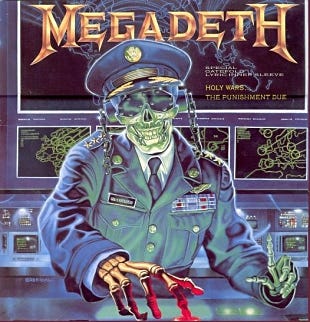
Peace sells, but who’s buying? - the cost of war as of writing today
It has been 19 days since February 28th with the first strikes and bombs and bombs striking Iran, though it all feels like years feeling like decades and decades feeling like years or whatever that Lenin quote is about time passing. It’s been 19 days is my point.
As of writing on March 18th going into the 19th:
Amnesty International confirmed that a US Tomahawk missile hit an Iranian primary school in Minab, killing at least 170 people.
Of those 170 people killed, 160 of them were those schoolgirls. They were children.
As of March 19th:
At least 1,444 people have been killed and 18,551 injured in Iran according to Iran’s Ministry of Health.
An estimated 4,800 members of Iran’s military forces have been killed according to the Hengaw Organization for Human Rights.
15 civilians are dead in Israel with over 3,600 injured.
The war has spread to Lebanon where more than 700,000 people have been displaced.
Thirteen American service members are dead with about 200 wounded.
Israel is systematically assassinating Iranian leadership. Earlier today, Israel struck South Pars, the world’s largest natural gas field, with US coordination, disabling most of Iran’s gas production and halting the flow of gas from Iran to Iraq.
Trump posted on Truth Social tonight that the United States “knew nothing” about the South Pars strike, then threatened to “massively blow up” the same field himself if Iran keeps hitting Qatar.
In turn, Iran retaliated by hitting Qatar’s Ras Laffan LNG complex with missile while Qatar expelled Iran’s military and security attachés from the country.
Do you also need a flow chart or some type of graphic to keep up with all these main characters? I do.
The IRGC issued an evacuation order warning Gulf energy facilities are now “direct and legitimate targets” and that attacks will not cease “until their complete destruction.” Over 3,000 projectiles have been fired at GCC countries, more than half targeting the UAE. Iran is also escalating from airstrikes to naval attacks as a ship was struck by a projectile off the UAE coast near the Strait of Hormuz late tonight, bringing the total to more than 20 ships hit since this war began. The Gulf economies are suffering their worst damage since the 1990-91 Gulf War.
Despite all of this, suspected Iranian tankers were still loading oil at Kharg Island this week, days after Trump ordered strikes on the export hub. That means kill chain’s target is still technically operating.
Oil surged past $110 after the strikes on energy infrastructure and the Strait of Hormuz remains effectively closed. While the US is dropping 5,000-pound bunker busters on Iranian missile sites along the Strait, White House press secretary Karoline Leavitt went on Fox News today and said “We don’t need the Strait of Hormuz for our energy here at home.”
Despite all of this, the top US counterterrorism official, Joe Kent, resigned, saying “we started this war due to pressure from Israel and its powerful American lobby” and that Iran is “not a threat.” In his first interview since resigning, on Tucker Carlson, Kent said there was “no intelligence” that Iran was planning any imminent attack, that Israel had pulled the US into the conflict, and that Rubio’s justification was circular: the “imminent threat” was that Iran would retaliate if attacked, not that Iran was going to attack unprovoked. The FBI is now investigating him for alleged classified leaks. Senator Murphy said after a classified briefing that the war’s actual goals do not include destroying Iran’s nuclear program or regime change. Iran’s Foreign Minister called the whole thing “Operation Epic Mistake, a misadventure engineered by Israel and paid for by ordinary Americans.”
As all of this is happening, Treasury Secretary Scott Bessent issued a 30-day sanctions waiver on Russian oil last week to “promote stability in global energy markets.” The architect of the dollar weapon against Iran is now easing dollar pressure on Russia.